Delivery and operations · Budget settings and approvals verification
Proving a budget-settings save leaves other advertiser fields intact
Source-reviewed technical draft. Diagrams and walkthroughs use abstract or invented inputs. Implementation, reported use and measured outcomes remain separate.
My budget-related work includes a specific testing problem: the advertiser settings interface changed, but the writer test still depended on removed selectors and an old save action. A green optimistic form state would not prove that the intended fields persisted or that unrelated fields survived the write.
I repaired the evidence path around that save.
Match the operator's actual action
The authored change adds semantic names to the advertiser name and Sheets URL inputs, plus switch role and checked state to the external-sync control. Its component tests navigate the Budget & Groupings section and use the dedicated Save Budget & Integrations command.
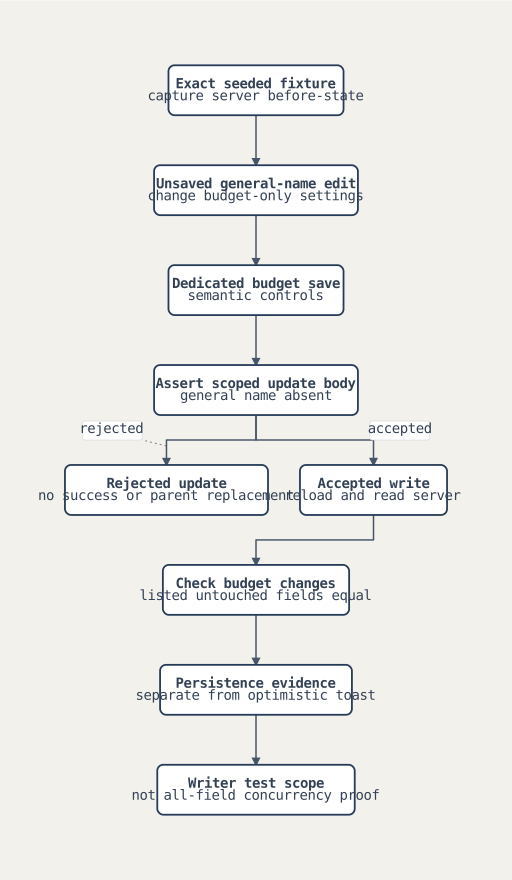
The test deliberately leaves an unsaved general-name edit in the form.
I use that fixture to check a real boundary: the budget-only action should not leak general edits into its payload. The authored unit cases exercise the sync control starting both enabled and disabled. They assert the exact update fields, preserve parent data on rejection and avoid unexpected network access through mocked dependencies.
Those are historical test assertions. I inspected the source and did not rerun the employer suite or perform a live advertiser write in this research session.
Inspect the system diagram
A toast is not a persistence check
The writer test identifies one exact preseeded advertiser and captures its initial server record. It waits for the precise update request, checks its body and response, then reloads and captures a fresh server read. The after-state assertions compare the intended settings and a list of unrelated identity, ownership and integration fields with their original values.
I made persistence evidence independent of the form.
The scoped implementation preserves the existing service, handler and payload behavior. It repairs selectors, control semantics and tests; it is not a new budget persistence engine. The explicit field list catches the chosen regression class, but it does not prove every possible advertiser field or concurrent-write scenario is protected.
Failure behavior is equally useful. The component test rejects the update, expects an error, withholds parent-data replacement and success text, and leaves the save action available. That protects the operator from a false success state in the tested branch.
Keep read-only smoke checks from requiring seeded writes
The authored change moves a seeded flight-group assertion into a nested describe block that registers its read-only skip before inherited setup hooks demand seeded data. The hard assertions remain for the seeded mode: flight grouping, expansion, segment rows and populated timestamps.
That change preserves two different test purposes.
I would explain why a test skipped for a read-only deployment smoke is not evidence that the writer behavior passed. Conversely, a writer regression test should not be weakened into a skip when its seeded fixture is available. The case study keeps those results separate and makes no claim that either mode ran during this research.
The contribution census also records my approval on the authored change, authored by another engineer. It is peer-review activity, not implementation authorship. The other captured review event is a comment on my own retail PR and is not another independent peer review.
Invented regression walkthrough
- Load a fictional preseeded advertiser with a name, owner assignments and integration fields.
- Change the name without saving it. Enter budget settings and update only the external-sync control and Sheets URL.
- Inspect the update body to confirm the unsaved name is absent.
- Reload and read the server record. Compare changed budget fields and preserved unrelated fields.
- Reconstruct an update rejection and show error feedback without a success toast or parent-data replacement.
- Compare read-only smoke mode with seeded writer mode. Identify which assertion was executed and which was intentionally skipped.
This is an invented test walkthrough, not a live writer sweep or a recorded production incident.
Result and contribution scope
My merged changes support a more meaningful budget-save regression test, accessible control semantics and correct separation of seeded versus read-only test setup. They do not establish ownership of the whole budget tracker, prevention of every data-loss class or measured incident reduction.
Discussion notes
Three-minute outline. describe the stale test path; show unsaved-name leakage as the regression target; explain request and fresh-read evidence; finish with the read-only smoke boundary.
Questions to prepare. What does optimistic UI establish? Which fields need preservation checks? How would concurrent edits change this test? When is a skipped test an appropriate scope boundary?
Application summary. I repaired budget-settings verification so it checks the operator's current save action, the exact update payload and a fresh server read while preserving unrelated advertiser fields. I also separated seeded writer checks from read-only smoke setup. That shows how I turn a failure report into concrete, reviewable evidence about a deployed workflow's contract.
This contribution narrative is supported by privately held source and authorship records. It contains original explanations and abstract diagrams, without employer code, customer records or runtime telemetry. Missing outcome evidence stays explicit.