Creative work and evidence · Creative trafficking and source review
Keeping creative suggestions attached to the right work
Source-reviewed technical draft. Diagrams and walkthroughs use abstract or invented inputs. Implementation, reported use and measured outcomes remain separate.
A trafficking matrix connects creative files, placement variants, copy, naming and destination URLs. My Creative Matrix contributions addressed both sides of that job: making source discovery and grouping work, then making the suggested associations reviewable before they change the matrix.
An attractive preview is not enough if the wrong copy lands on a valid asset.
Discovery had to become diagnosable
The contribution history records a progression from folder scanning and authentication repairs to an extract, match and review pipeline. Grouping evolved through filename normalization, content signals and model-assisted matching. Later work added a manual workbench, governed templates, copy association and launch-readiness checks.
One failure has a narrow, inspectable fix. The authored change removed corpora: allDrives from the non-drive-specific listing branch while retaining corpora: drive and driveId when a shared-drive identity was known. The changed query options are visible in the diff.
My history around that fix includes several earlier authentication and scanning attempts. I would explain them as integration debugging, not imply that every intermediate patch independently proved correct access. Diagnostics and a zero-file result need enough context to distinguish an empty folder, unsupported files and a failed read.
Inspect the system diagram
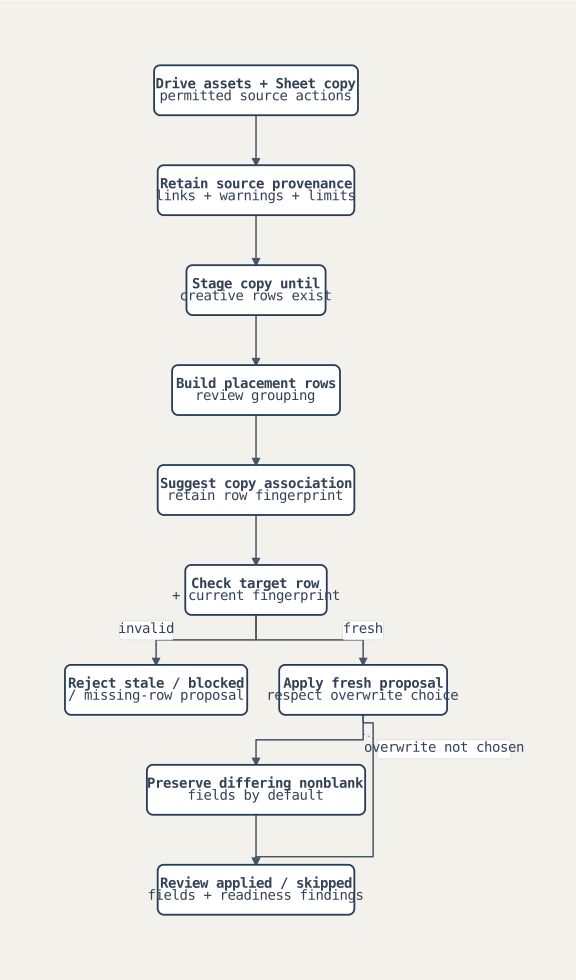
This model focuses on source and copy association, not every model-assisted grouping branch.
Keep source discovery separate from applying copy
The authored change distinguished Drive creative assets from Google Sheets copy, hoisted copy mapping into shared state and allowed copy to be staged before creative rows exist. The inspected hook diff exposes that staged-without-rows state explicitly.
The authored change retained cell metadata so a visible label did not erase its hyperlink, rich-text link or formula-derived URL. Its source manifest records provenance, warnings and truncation limits. Discovering a Drive link does not automatically grant access to its target.
I keep those boundaries visible in the story.
Importing source metadata, exploring a linked folder and applying a copy suggestion are separate actions. In the inspected configuration parser, copy import, mapping, suggestions and bulk acceptance have dependencies; a dependent flag cannot silently enable its prerequisite. Other integration modes distinguish off, mock and read-only behavior from unsupported live-write modes.
A suggestion can expire
The inspected copy-association reducer rejects a blocked suggestion, a missing target row or a target whose fingerprint changed. By default, it also preserves a nonblank field with a different existing value. An explicit overwrite option is required to replace it.
That is the important review contract.
My case study treats a model or matcher suggestion as a proposal tied to a particular row state. It does not become permanent authority because it was once generated. If a user edits the row, applying an old suggestion must account for that edit. Skipped fields and no-change outcomes remain visible to the calling workflow.
Filename grouping provides a useful fallback, but normalization can merge unrelated names or lose meaningful tokens. The inspected fallback labels its confidence as fallback_normalization; it is not an evaluated probability. The full model-assisted grouping history still needs its own revision and outcome review before any accuracy claim.
I would evaluate grouping against labeled examples before reporting accuracy.
Readiness and later governance
The merged the authored change added copy, CTA, URL and asset-spec checks with a Green/Orange/Red verdict. Its PR records a local build limitation from missing environment variables; a green verdict in that feature is not proof that a campaign was launched.
The campaign still needs provider execution and confirmation.
My September history extends this into guided intake, template auto-confirmation, mapping recovery and lifecycle persistence. The authored change describes template fingerprints and preflight before workbook creation. These later records establish the breadth of the contribution trail. Exact later contracts and deployment outcomes require further inspection.
The standalone Creative Audit tool belongs in a separate chapter. Its model-generated evaluation scores are a different operator decision from trafficking association.
Invented stale-suggestion walkthrough
- Import copy from sheet
Launch Copywhile the matrix has no creative rows. Keep the import staged. - Discover a Drive folder link from a labeled cell; explore it only through the permitted source action and access context.
- Create two placement rows for concept
Spring Offer. Generate a copy association against row fingerprintrow-A. - The operator edits the headline. The fingerprint becomes
row-B; the previous suggestion is rejected as stale. - Generate a fresh suggestion. A different nonblank description is preserved unless overwrite is explicitly chosen.
- Inspect skipped fields and spec findings. A readiness verdict remains a review input, not a provider launch receipt.
Contribution and application assets
My record supports original work on source integration, grouping, workbench state, copy contracts and readiness. It does not establish a measured grouping accuracy, the PR-title model cost reduction, hours saved or current user volume.
Discussion notes
Three-minute outline. explain the matrix's source/copy relationship, show the Drive listing failure, then demonstrate a stale row and preserved manual edit.
Questions to prepare. Which discovery action reads external data? What makes a suggestion stale? How does overwrite change the contract? How would grouping quality be evaluated?
Application summary. My Creative Matrix work connected asset and copy discovery to a reviewable trafficking workflow. I worked on integration diagnostics, staged copy association and safeguards that reject stale suggestions and preserve existing edits.
This contribution narrative is supported by privately held source and authorship records. It contains original explanations and abstract diagrams, without employer code, customer records or runtime telemetry. Missing outcome evidence stays explicit.