Integrations and shared platform · Identity, delegated access and authorization
Identity that an operational workflow can use
Source-reviewed technical draft. Diagrams and walkthroughs use abstract or invented inputs. Implementation, reported use and measured outcomes remain separate.
I contributed authorization, credential recovery and external identifier resolution in Atlas. The connected problem is that being signed in does not automatically mean a workflow has the right permission, a usable Google credential or a verified identifier for its recipient in another service.
Those are separate decisions.
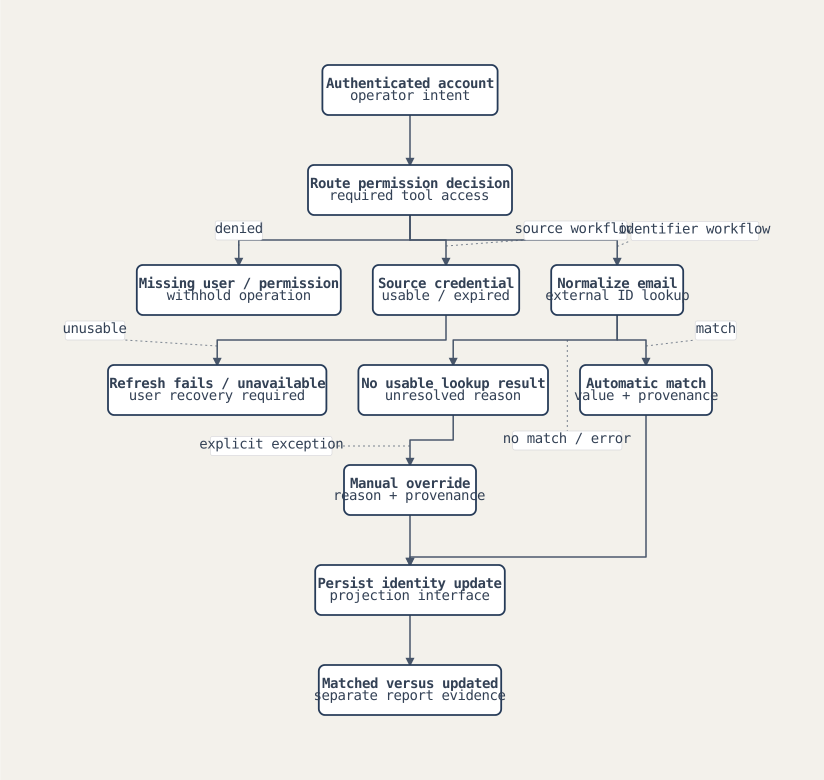
The authored change adds a dedicated Taxonomy administration guard and applies it to selected administration routes. The inspected guard distinguishes a missing authenticated user from a user without the required tool permission. I describe that as enforcing a specific server-side permission contract. I do not claim the patch alone establishes a complete security audit of Atlas.
Recover credentials without losing continuity
The authored change preserves an existing Google refresh token when a later credential update does not include a replacement. The selected access-token path also handles an expired stored credential explicitly: attempt refresh when possible and return a recovery-required outcome when refresh fails or no refresh credential is available.
I would walk through the expired branch, because that is where a successful sign-in can otherwise mislead an operator about whether their source integration is usable. The inspected version trusts an access token without expiry information, so I do not claim universal token validity or scope verification.
The history then changes the user flow.
The authored change removes selected manual-link prompts and leaves compatibility redirects for deprecated linking routes. Its narrative describes automatic linking at sign-in; the inspected removal patch does not independently prove every token-persistence path. I keep that dependency visible and do not present the earlier recovery flow as the current interface at every revision.
Inspect the system diagram
Resolve external IDs with provenance
The authored change adds email-based Teamwork and Slack identifier resolution. The service normalizes email, checks a Teamwork roster and calls a Slack lookup. Results retain resolved or unresolved states, reasons and timestamps. Stored provenance distinguishes automatic lookup from a manual override.
I can show why provenance belongs beside the value.
A recipient ID entered by hand is a different kind of evidence from an ID returned for a normalized email. The manual override requires a reason; the backfill preserves those overrides by default and supports an explicit force mode. Identifier updates can pass through the DRI projection-mutation interface, connecting identity changes with routing evidence.
The selected roster fetch requests a bounded page and does not implement a page-following loop. A comment describing a complete roster does not establish complete directory coverage. Lookup failures and missing people remain unresolved; the service cannot prove there is no matching person outside the returned page. Its provenance fields are ordinary stored metadata, not a cryptographic tamper-proof record.
Backfill reporting also separates matched identities from users whose updates were successfully saved. I would retain that distinction in any operational rollout. A successful lookup and a persisted correction are different events.
Invented onboarding walkthrough
- Show fictional user Alex with an authenticated account and no Taxonomy administration permission. Explain the server-side decision without using real accounts.
- Reconstruct an expired stored Google credential with a retained refresh token; then show the recovery-required branch after refresh failure.
- Resolve Alex's invented email to a synthetic external roster entry and display the provenance fields.
- Mark a second identifier as a manual override. Show the default backfill preserving it.
- Omit an entry from the bounded roster. Explain why unresolved lookup does not establish complete-directory absence.
- Reconstruct a persistence failure after a match and compare matched versus updated counts.
These are toy states. No actual credentials, user directory entries or provider requests appear in the walkthrough.
What I can claim
The selected authored patches establish defensive route guards, refresh-token preservation, flow simplification and provenance-bearing external identifier resolution. I do not claim eliminated security incidents, complete directory matching, measured onboarding speed or sole ownership of Atlas identity.
The practical contribution is connecting the identity needed for a person to sign in with the identity and evidence an operational workflow needs to act correctly.
Discussion notes
Three-minute outline. sign-in versus usable integration identity; the refresh-token continuity fix; email-based external IDs; manual overrides; bounded coverage and persistence outcomes.
Questions to prepare. What is authoritative for a recipient? How do overrides expire or get reviewed? How should directory pagination work? What evidence invalidates a routing projection? How do authentication and tool authorization differ?
Application summary. I contributed the identity controls needed by operational automation: server-side permission decisions, credential recovery and external recipient resolution with provenance. I can explain the difference between a signed-in user, a usable integration and a successfully persisted recipient mapping, including the gaps that still need rollout verification.
This contribution narrative is supported by privately held source and authorship records. It contains original explanations and abstract diagrams, without employer code, customer records or runtime telemetry. Missing outcome evidence stays explicit.