Integrations and shared platform · Engineering intelligence, tests and agent governance
Keeping engineering evidence attached to what was checked
Source-reviewed technical draft. Diagrams and walkthroughs use abstract or invented inputs. Implementation, reported use and measured outcomes remain separate.
I contributed engineering tooling that asks a simple question before reporting success: what evidence supports this result? The work spans staging test identity, schema validation and recurring engineering reports. They share a failure mode. A report can look complete while its target or denominator is incomplete.
Bind the verdict to the served commit
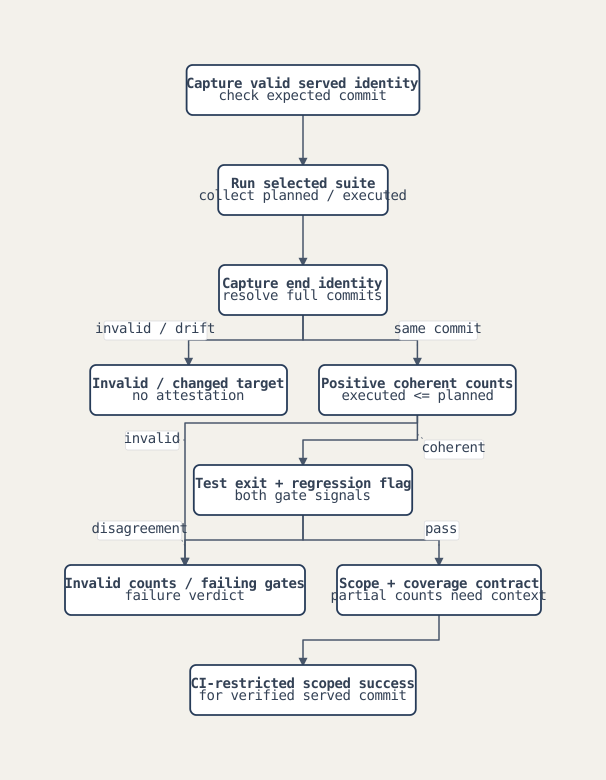
The authored change changes the staging QA workflow and helper to capture the served build before tests, compare it with an expected commit when supplied, and resolve the observed identity to a full GitHub commit.
I would lead with a deployment that changes while tests are running.
The helper requires valid start and end identities and refuses attestation when the resolved commits differ or the drift signal is not explicitly clear. It also requires a recognized suite scope and positive, coherent planned and executed counts. A successful verdict needs the test exit, product-regression flag and both gate signals to agree. Publishing success is restricted to its CI path outside dry run.
The counts still need careful interpretation. The selected helper allows executed count to be less than planned count if the other gate signals pass. It does not alone establish exhaustive suite execution. The workflow's test collector and gate must supply that stronger completeness guarantee. I do not claim a passing Atlas run from inspecting these rules.
Inspect the system diagram
Parse contracts instead of finding suggestive text
The authored change replaces a small efficiency-schema text check with a TypeScript syntax-tree validator. The selected implementation extracts exported usage actions, default time-saving entries and zero-value actions. It checks supported declaration shapes, duplicate keys or values and overlap between categories, then cross-validates their membership.
I can demonstrate why syntax matters here.
A string appearing in a comment is not a configured action. An exported object with unsupported expressions is not the literal contract the validator expects. Explicit baseline exception sets retain known unclassified or external entries; validation is bounded by those assumptions rather than silently asserting every action has empirical value.
This validates configuration consistency. It does not measure minutes saved or validate the economic assumptions behind a default rate. The related Command Center study explains the difference between observed usage and modeled efficiency.
Keep unknown different from zero
The same contribution makes quality-report handling distinguish unavailable or malformed check evidence from success or failure. A pending latest check remains unknown. The recent-PR query records a possible truncation condition at its bounded result limit; a no-data state is distinct from a favorable rate.
I also changed what the reports claim.
Selected bug analytics exclude NOT_PLANNED closures from the resolution-time calculation and explicitly mark reopening activity unavailable without timeline evidence. Documentation watchlist copy explains that a row disappearing from a churn window does not prove semantic documentation accuracy. These are evidence-definition changes, not measured reductions in bugs or maintenance time.
Invented tooling walkthrough
- Give a synthetic test run different start and end commits. Show refused attestation.
- Keep the commit stable but provide zero executed tests. Show that a favorable exit alone is insufficient.
- Supply coherent positive counts with a passing gate, then discuss why partial planned coverage still needs the collector's contract.
- Parse a toy usage-action object with a duplicate value and a comment containing an unused action name. Explain the syntax-tree result.
- Compare a pending check, an empty recent-PR window and a truncated query.
- Show a documentation row leaving the churn window without claiming the document became accurate.
This reconstruction publishes no status and queries no live engineering service.
Contribution and limits
The authored merged patches establish these particular quality-evidence and reporting corrections. The wider contribution matrix retains tooling documentation, analytics and maintenance history, including proposals that did not merge. Closed authored changes contains substantial inherited branch history; its commit count is not a count of new tooling work delivered by me.
My strongest interview point is preserving the meaning of a quality result. The tooling should name its target, state its coverage and expose unknown evidence before anyone uses the summary to make a release decision.
Discussion notes
Three-minute outline. served-build drift; coherent execution evidence; AST versus text; unknown report states; the limits of a quality summary.
Questions to prepare. What exactly is attested? Who owns the test denominator? Why use an AST? How do baseline exceptions evolve? What does an unavailable metric look like to an operator?
Application summary. I contributed tooling that binds QA evidence to a verified served revision and makes schema and recurring-report assumptions explicit. I can explain the remaining coverage boundaries instead of treating a green check or favorable percentage as complete proof. That is useful for making customer deployments reviewable and debuggable.
This contribution narrative is supported by privately held source and authorship records. It contains original explanations and abstract diagrams, without employer code, customer records or runtime telemetry. Missing outcome evidence stays explicit.