Integrations and shared platform · Builds, CI and deployment recovery
Knowing which environment and build a check describes
Source-reviewed technical draft. Diagrams and walkthroughs use abstract or invented inputs. Implementation, reported use and measured outcomes remain separate.
I contributed release workflow fixes around environment stabilization and database targeting. These are small-looking changes with a concrete operational purpose: a check should run against the intended environment, and a nonproduction release should use its explicitly selected database configuration.
The release workflow needs to answer both questions before its result is useful.
Normalize the health response before comparing it
The authored change fixes a health-probe status-concatenation problem in the development, staging and QA workflows. The previous failure path could append another fallback status to curl's output. The correction collects the raw result, takes the final status characters and supplies a fallback only when needed.
I would show the failing representation and the comparison it broke, using synthetic values.
The patch also increases the stabilization loop from twelve attempts to twenty-four, retaining a per-request timeout and pauses between attempts. The request timeout contributes to elapsed time, so I do not describe it as an exact four-minute deadline.
The selected workflow accepts HTTP 200 from its database-aware health route as the condition to continue. That is the workflow's gate. Its comments describe initialized database shards, but this workflow patch does not independently establish everything checked inside the route or complete application readiness.
Make database selection explicit
The authored change adds a dedicated nonproduction Firestore configuration and passes it explicitly from development and staging deployment workflows. The inspected configuration names nonproduction administration and taxonomy databases and their index files.
I treat that as a destination-selection improvement.
It reduces reliance on a default configuration when a workflow chooses database targets. The selected file declares indexes; I do not turn the workflow step's broad label into proof that every ruleset, IAM boundary or production environment is fully isolated. No deployment run was performed for this study.
Inspect the system diagram
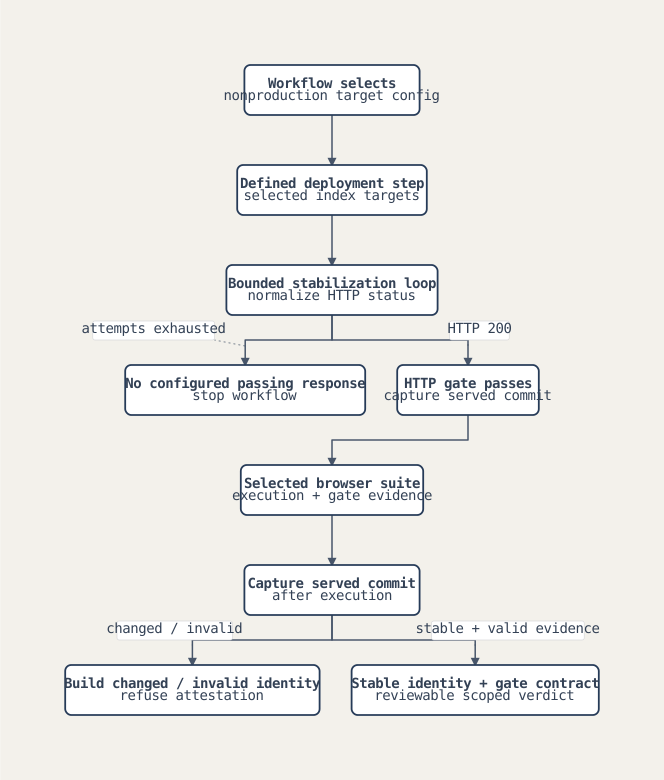
A healthy environment still needs a build identity
The related engineering-tooling chapter covers the authored change, which binds a staging QA verdict to the commit served at the start and end of execution. That is the next question after an environment responds: what did the browser tests exercise?
I do not count this shared contribution twice as impact. The release chapter explains where the attestation belongs in the workflow; the tooling chapter explains the helper's evidence contract and remaining completeness limits.
This also connects to the original proofing and auditor studies. Their correctness claims depend on a particular implementation revision. A passing check against a different served build cannot validate that revision, even if the branch names look right.
Invented release walkthrough
- Open a synthetic staging workflow plan and identify its selected nonproduction database configuration.
- Reconstruct a curl failure output and normalize it into the comparison value.
- Reconstruct two unsuccessful health probes followed by an HTTP 200 response. Show the workflow proceeding only on its configured condition.
- Identify a served build at test start and change it before test end. Explain why the later attestation refuses that verdict.
- Keep database-target selection, health response and build identity as three separate pieces of evidence.
This is a workflow reconstruction, not a deployment or a live health check. It includes no actual database names, provider projects, tokens or customer records.
What changed, and what remains unmeasured
The authored merged patches establish corrected status handling, a longer bounded stabilization loop and explicit nonproduction database configuration. I can trace those changes to their workflow lines. I cannot claim reduced deployment failure frequency, prevented production writes or faster releases without comparable run records.
My interview story is about making release evidence specific. The destination, readiness condition and served revision all matter. A green result loses value when one of those identities is unclear.
Discussion notes
Three-minute outline. wrong status representation; explicit deployment destination; health gate; served-build drift; the runtime evidence needed to measure release improvement.
Questions to prepare. What does the health route prove? How do you identify a served build? What should a database config include? Where are promotion and rollback evidence recorded? How do you prevent a successful test against the wrong environment from becoming approval?
Application summary. I contributed release controls that make environment targeting, stabilization and tested-build identity explicit. I can explain what each check proves and the runtime evidence still needed to measure improvement. That is useful when customer automation must move through environments without losing track of its data destination or validated revision.
This contribution narrative is supported by privately held source and authorship records. It contains original explanations and abstract diagrams, without employer code, customer records or runtime telemetry. Missing outcome evidence stays explicit.