Integrations and shared platform · Platform consolidation and module evolution
Keeping a growing platform understandable to its operators
Source-reviewed technical draft. Diagrams and walkthroughs use abstract or invented inputs. Implementation, reported use and measured outcomes remain separate.
I contributed platform work that helped operators understand what was available, what stage a tool was in and what had changed. These concerns sit between individual applications: a lifecycle record, an application-status response and a release summary all need to agree with the interface consuming them.
The useful story is consistency across those boundaries.
Make the configuration shape match its consumer
The authored change corrects application-config API responses to return an appStatusMap envelope. The administration write path also extracts that envelope from the request and returns it after updating the map. The inspected patch includes regression assertions for the two endpoints.
I would explain this through a concrete before-and-after response shape. The data could exist on the server while the interface expected it at a different property. Naming the shared envelope makes the mismatch inspectable. The selected validation checks an object-shaped value; it is not a complete per-application schema validator or an audit of every configuration consumer.
Let a tool enter the lifecycle model
The authored change changes a lifecycle-update path that previously returned not-found for a missing tool record. It creates a record with the supplied or default stage, target teams, resources, touchpoint states and actor/timestamp metadata. A separate interface correction improves visibility of inactive toggles.
I keep the metadata distinct from adoption.
A stored beta or launch stage represents the operator's lifecycle classification. It does not establish that a tool has users, completed training or reached measured outcomes. This connects to the Command Center chapter, where usage evidence and modeled efficiency have their own contracts.
Turn release records into a readable summary
The authored change introduces a changelog service that fetches recent GitHub releases, asks a model to organize their notes into UI categories and caches the result. The authored change aligns its credential-variable reference with the deployment configuration.
I can show the intended operator experience without calling the model's output authoritative.
Inspect the system diagram
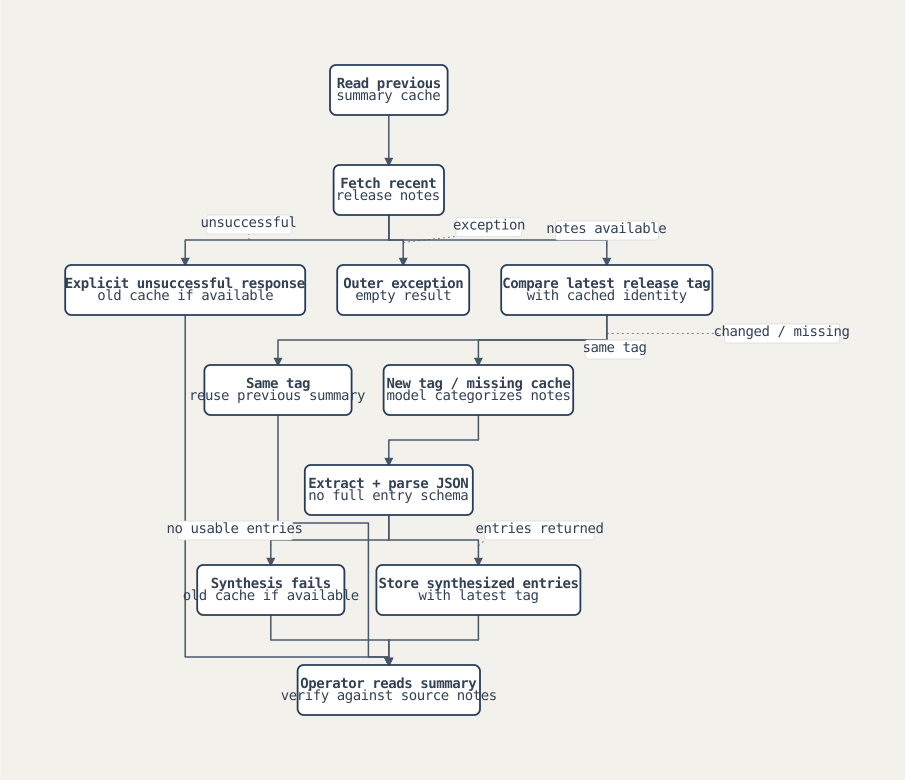
The selected service reuses the cache when the latest release tag matches. On an explicit unsuccessful GitHub response or failed synthesis, it can return the older cache. An outer exception returns an empty result. Those branches are different, so I do not claim that every failure preserves the previous summary.
The cache identity is also narrower than the source content. Editing release notes under an unchanged latest tag can leave the previous synthesis in place. The model response is extracted and JSON-parsed into an asserted type, without a complete runtime schema check in the inspected version. The service takes recent releases without implementing the production-only filtering discussed in its comment.
The next iteration would version the release content and prompt, validate generated entries and show freshness/provenance in the interface. Those are proposed improvements. The delivered contribution is the release-to-summary pipeline and its configuration correction, not a verified error-free changelog.
Invented cross-tool walkthrough
- Give a fictional app a status map and compare the raw map with the envelope the interface expects.
- Create an invented lifecycle record with an untracked stage and blank touchpoints. Explain why a later stage label is not adoption evidence.
- Supply two fictional release-note records and show the proposed UI categories.
- Keep the latest tag unchanged while editing the source notes. Explain the selected cache's invalidation limit.
- Reconstruct a provider error and a thrown exception separately, showing their different fallback outcomes.
- Review a generated entry against its source release rather than accepting valid JSON as factual correctness.
This is a synthetic reconstruction. It makes no lifecycle mutation, provider request or model call.
Contribution and result
The authored patches establish these configuration, lifecycle and release-communication contributions. The wider coverage matrix groups additional cross-tool maintenance and documentation into supporting platform sections while retaining their original dispositions. Separate design, release and migration chapters carry their substantial independent work.
I do not claim improved adoption, communication accuracy or platform-wide productivity without outcome evidence. My interview story is maintaining a coherent operator experience as applications and interfaces evolve, including checking where metadata and generated summaries stop short of proof.
Discussion notes
Three-minute outline. the response envelope mismatch; missing lifecycle records; release-note synthesis; cache/fallback boundaries; the evidence needed for operator confidence.
Questions to prepare. Which metadata is authoritative? How do you version generated summaries? What should the interface show when cache freshness is unknown? How does lifecycle stage differ from use? How do you keep a shared API shape consistent across consumers?
Application summary. I contributed cross-tool configuration, lifecycle and release-summary workflows that make a growing platform easier to understand. I can trace the interface contracts and generated-content boundaries, including the difference between a stored stage, a readable summary and verified operational evidence. That supports customer deployment work beyond the first feature launch.
This contribution narrative is supported by privately held source and authorship records. It contains original explanations and abstract diagrams, without employer code, customer records or runtime telemetry. Missing outcome evidence stays explicit.